Showing posts with label Simulationist. Show all posts

Wednesday, 24 May 2017

Does Story trump rules? Only in cartoons and comedy

Over at Raging Owlbear, There is a thread about how Story trumps Rules. He makes some good points, yet at the same time misses some (IMHO) critical issues. This is not just Owlbear, This has been seen across the board with so many threads on so many forums, and its really scary that anyone should/would box RPGs up, to exclude anyone that doesn't agree with this.

If you haven't or are not going to read it, or just to clarify what I think he's saying:

Story Trumps Rules:

Owlbear talks first about how rules provide a framework for us to tell a story so we can have fun. He then goes into why you should not break the rules, I agree . Then how you should learn the rules, so you can know when to break them.. and lastly, When to break the rules, mostly this was "is it fun? then break the rules"

Whose fun?

The bulk of the posts these days seems to be "oh, the situation is too hard, just let them have their fun, scale down the difficulty, pull out the problems, let the players have fun"

At whose expense?

Owlbear doesn't go down this path, he uses example that seem fair, realistic, but read between the lines, and you can see that none of these 'rules' needed to be broken.

How do I portray this to you, the reader, clearly.. How about this: for the older crowd: We all knew it was illegal to record shows from TV onto a VCR and watch it later, the law was to stop people from setting up micro-cinemas, and showing lots of people, denying the production company the money to pay for the movie/show. For the younger crowd, Its Illegal to record Youtube Videos, and watch them later, same reasons. Yet people do it, why? because the rule is broken, its a blanket rule to cover all situations. Laws can't cover all instances fairly, neither can roleplay game rules. and that's why the Gamesmaster exists, She/He can gauge the situation and determine, does that rule apply to this situation or not.

Scafford of Consistency

When Owlbear talks of not breaking the rules, he talks of Consistency: A scaffold of consistency allow players agency to use their own world knowledge to play the game without needing to know the rules off by heart. If in real life, they think they can jump from a pillar to a window frame, they should be able to, If in real life, they can 'target' the head, with their sword swing, they should be able to. The Rules, are supposed to be an abstraction of physics to game mechanics, to allow players to do what they want to do.. or at least try.

Newer GMs

Newer GMs don't know when to use rules and when they don't, Often they'll break immersion to look up a rule, players go off, get a drink, return and have lost some of the flow of the game. so GMs learn quickly or look up on the internet how to do it better and what do they hit first?, 'break the rules to make sure the fun doesn't stop' and like the VCR/Youtube example above, they'll do what everyone does. to get done what needs to be done, so the game doesn't come to a crashing halt.

One of the reasons I advocate that new GMs should first be DMs, is to get familiar with a stricter set of rules. Dungeonworlds: Dungeon Delvers Twelve, puts the DM in charge of a dungeon, players have a more structured environment, a Dungeon, to get familiar with the rules, but so does the DM. Over time, after learning how to run a dungeon a few hundred times, they might advance to GM to deal with the outside world, the travel between locations, the open world, the sandbox and all the aspects of roleplay that both players and GMs need to get used to.
As they go though, they'll get used to what rules work in certain situations, but not others. If a rule doesn't exist, (like 99% of the time) the GM has likely learnt enough on how to gauge the situation, use a rule that matches best, and if no rule exists, make a ruling on what to do. No rule has been broken, players can maintain consistency, keep their agency and get on with the game, without thinking "Oh, the GM just fudged that, ok, so I don't need to think about what I can do, I should instead think about what is cool, fun, exciting and the GM will allow it, because 'fun!'.

Maybe they do that subconsciously, maybe the make a decision to do so, I know I fell into the trap, when my GM wanted my character to succeed, I felt no push-back to my antics, so I just kept pushing, not on purpose, just to know the limits. I quit the game when I should have died for the 3rd time and he just hand waved me through.. for plot.. sorry, I want to enjoy the challenge, and to understand the challenge, I need to know the bounds of the game.

What kind of fun? What kind of story?

Everyone has an opinion of what fun is, as they do what a story is. Romeo and Juliet is a classic tragedy, its an awesome story, its known around the world, yet I can't see a shred of fun in it. So why does fun trump story again? I think restricting all forms of roleplay to only 'fun' stories, is like limited TV to only cartoons and comedy. when so many other genres exist...

This is really another topic, but at the core of what we're talking about:

Limiting Roleplay to Plot and Story is, to my mind, akin to Railroading. Any kind of decision by the forces of nature (the GM) that pushes the plot in any direction, especially for Plot (story) will be viewed by the players as taking away their agency. So if Fun trumps Story.. doesn't that mean that guiding the game, to be more fun, is another form or railroading? What if the natural progression of the 'story' is to become a classic tragedy? If the GM obeys the fun rule, it forces a comedy, from what could have been an awesome tragedy, to something in the middle, and no-body wins.

Yes, Personally, I'm a Sandbox GM, I think we create stories in real life from moments of the mundane, I went to the shops, met a man, who sold me some beans for my cow and when I got home my mother scolded me.. Each of these events are fleshed out in roleplay, and more so in life, but when we tell them later, we only state the sentence that sums up all those events "met a man", did a GM somewhere make an encounter roll? sure, and he did so for the 20 people that met that man before me, but each one failed to swap the beans, and they went to different stories, not one of them is going to include the "met a man with some beans" in their story, unless its somehow relevant. Not everyone has the beanstalk 'fun' but for some reason, this topic keeps popping up, telling new GMs, misguiding them from the path for this 'fun' version of roleplay.


Saturday, 8 April 2017

Craft Based Roleplay - the Missing Element

     While some might think its a bad idea to reveal your ideas, lest someone steal them for themselves, I don't think that either my idea is new, nor unique, just that I'll be adding it in a way that hasn't really been done in roleplay games. Crafting for adventurers...

Crafting for your Roleplay Group

     One thing that irked me in many systems for years was the inability to really make a half decent magical weapon. At least with a semi-realistic sense of the idea.
     My first encounter with the crafting rules was from Dragon Warriors, Book 2: Simplistic at best, once a Mystic reaches 4th rank, they can begin to craft +1 items, 6th for +2 and 9th for +3. The mystic must go off to a place to remain in solitude, and fast in order to 'attune' themselves to the mystical powers and then begin the 'creation' of an item. There is no talk of 'costs' other than time, 25 days to make a +1 arrow, 100 days for +1 weapon or armour, up to 1500 days for a +3 weapon..
     Yes its simplistic and flawed, A party could leave their 9th ranked Mystic off in some wilderness 'creating' the Warrior a +3 set of Studded Leather armour, and the group returns 1500 days later, now all 15th ranked characters, having acquired several other +2 and +3 sets of armour that are as good if not better from quests and such.. sorta defeated the purpose of creating magical items in the first place.
     Sure a GM could attempt to balance the system, but what ever you do, you'd probably be spending hundreds of hours coming up with some kind of specialized algorithm, that'd break either game balance or usability.. 25 days for a +1 arrow? just to be shot and lost in the very next combat? It only gives +1 to attack, ABR and Damage, its not all that good.
     Dungeons and Dragons does it just as bad, there are countless blogs talking about it just seems to be a kind of 'cash sink' for the GM to ensure the players have a reason to go out looking for more quests, rather than retiring.. even though 12+ level characters are pretty much expected to retire (according to the older forms of the rules, it can be argued) and are only brought out for epic world ending events.
    Rolemaster, Tunnels and Trolls, Warhammer Fantasy Roleplay, they have their own rules & houserules, blogs about it, but at the end of the day its pretty much the same.. Heroes acquire treasure, heroes get rich, heroes have little need to quest for the mundane magical items such as +1 items, but they still have a basci need for them, heroes sink cash into NPCs that make the items, or they sink less cash but more time OR experience points (another sink system to keep mages from getting TOO powerful) into making magical items with broader choices.
     Seems like not many people really got into the whole crafting side of things... 

Could be just your experience

Yes, I understand, I haven't played every single game with every single GM, and there are likely some half-decent games that are all about creating interesting items. Yet if you read up on this, by the very creators of D&D it seems that I'm on par:
     "The statement "I want to make a magic item" has the power to freeze a DM's blood. Players, too, can find the item creation process intimidating. Sometimes these fears are justified, especially when someone invents an entirely new item and then wants to sit down and make it - Skip Williams"
    I have crafted some adventures where players are trying to acquire the material components of weird and wonderous items, while I agree that they should have some kind of 'cost' to acquire, I am more of the opinion that it should be a cost of risk vs reward rather than a physical cost.
     I would rather stick to the idea that making a sword, be it magical, mystical or mundane, should approximately be of the same time of a real sword, 2-3 days for the weapon & 2+ weeks for the flair, but its more about "getting it right" because maybe forging a sword and getting it wrong just means melting down the blade and starting again, but if your using elementium steel, then it likely involves a few enchanted tools, some runes of protection against it (so it doesn't freeze or burn you while forging) and you'd only want to deal with it once, rather than risking deadly burns or life altering frostbite twice.
     So instead the "cost" to acquire goods, is for the group to acquire the magical forge, the mystical hammer, the tongs of fire, the cooling Pools of the frostbanes and several kilos of Elementium, Elysiuum Wood, Gems of Brightfire and Rubies of Blood. Once acquired, the Blacksmith/Mage/Mystic of the group gets to work, while the heroes rest their wounds and 3-6 weeks later, the Smith presents the Leader/Warrior of the group with "FleshForger the Magnificent" with all the bonuses (and possible flaws) of the new weapon.

Yeah, we all do that.. so whats your point?    

     Recently, (well, ok, 3 years ago now) We were tasked at Uni to make a game, and my group agreed to try making a "potion making game", We only had 13 days in total to make it (well its over 13 weeks, we had 1 day a week assigned to the task, because of other subjects, exams, studies etc) so in the end we made a game where you chose 3 ingredients and dependent on how you mixed it, it would come up with 1 of 9 possible potions/poisons.
     Now, the key underlying aspect of the game, was to experiment


---------------------------------- APOLOGIES TO READERS------------------------
Due to Google downgrading their system, this post was lost, I managed to find this much via some fancy caching, but from this point forward, I am mostly trying to remember what I wrote, appologies if it seems out of sync. Originally Published 08/04/2017
----------------------------------------------------------------------------------------------

The Game

The Experimentation of how each 'part' worked, was the process of the game. In the 'morning' You acquired the 3 ingredients from the forest, randomly, mostly it gave you a 1:5 chance, twice, either gaining the whole plant, the roots, the leaves or the flower, or nothing( 2 chances). You'd return to your workshop by the end of the day, if you had purchased food from town you ate it, else you could eat the leaves or boil the roots as a substitute, no ill effects, just the loss of your days work looking for it.
Lastly, you could try to 'experiment' on your potions. Each of the three ingredients could be fried, boiled or crushed (for oils), no other information was given.
Oh and also you could go to town, in town you could buy food for 1 copper coin each meal, and meals could last 4 days (so you could buy 4 max) but while in town, you heard rumours.. someone was sick, someone had a toothache, someone wanted to poison her evil husband.
The only thing we had in the game was that all three paid money (3 copper), the 'bad' job would pay even for failed poisons, but a copper if you failed and 3 if you succeeded.
So each night, you'd make up some potions/poisons, and when you had a few, you could go to town, and try them out. The 'experiment' was on the evil husband, if he died, you knew it was a legit poison, if he didn't it sometimes made him happy, or angry or no effect.
This was the litmus test. Angry.. probably ill effects, happy, likely good effects, dead, most definitely poison.
Now at the heart of this, was percentile effects, Boil the root and you got soup, you knew this from your own experience, eat the leaves, its not killing you either, So boil the leaves? fry the leaves? crush the leaves? Each has an effect: From memory, Boiling, drew out the potent qualities, but not the oil effects, Frying would destroy the potent qualities, but keep the oil effects, and crushing, gave you a 50/50 effect of both, while eating it raw, would give you half of the potent effect, but all of the oil, So it became a maths puzzle..
Roots had 25% poisonous Oil, but 100% Nutitional Potent,
Leaves had 0% poisonous Oil and 25% healing Potent.
The Flower had 75% numbing Oil, and 10% Poison.

If you boiled the Roots and Leaves and fried the Flower, and threw away the Roots and boiled it again, you'd get a healing potion,
If you crushed the flower, added some raw, boiled the leaves and then threw out the leaves, you got a tooth numbing agent, so they could pull the tooth
and if you Boiled the flower several times, and fried the roots several times, then crushed the Boiled flowers into the roots, you got a deadly poison.   
---------------
The Key to it was trying out different combinations, on yourself, and the evil husband to figure out what did what, and how it came together.

In Roleplay

Firstly, to get this to work in roleplay, you need to have the ability of your group to get stuff made. Like stated before, getting the 'ingredients' is part one of the game, Having your players procure a Firebird feather, a Core of Sphagnum and a Dedicated Crystal, is the adventure that they get to go on.

But having the Unique Powerful item, is only interesting if it is Unique AND Powerful.

To Create this, you have to have more control over the flow of goods and services.

If your players like the idea of crafting their own gear, upgrading it, improving it, then make sure your setting works, Making standard items less common, with technological advances, just recently discovered.

Cavemen/Minecraft: The Most interesting 'inventions' game would be starting from scratch, players probably already know about sharpening stones & attaching them to sticks with vines, but how about baking clay to make moulds to heating fire hot enough to melt ores to even make metals.. Playing the game in a minecraft like environment might even be your players thing.

Shift of Ages: As the Bronze Age was in decline and the Iron Age beginning, we see a whole area of roleplay barely played. Have your entire group in the fall of rome, as the Gauls have just discovered Iron and Steel swords are a brand new thing. The Aquisition of Iron Ore becomes an adventure of its own. Or if your more inclined, Steampunk, as all manner of steam powered things get invented, and usually ones that would never work, steam powered mobile phone anyone?

Post apoc: My favourite (and one I'm building a new campaign for) When everything has gone to hell, and your players can't even get a decent weapon, unless the bring back some scrap metal from outside the safe zone.. This one ties in nicely with fantasy: The players have steel sword, but how to get EarthElementium? or Plogistonium. Bring back a chunk of Ever-cold Metal and have your blacksmith forge up one of those as a Cleaver! or Chukrum!

So, now that you've got the setting, Have an NPC in town, controlled by your rules lawyer/ numbers cruncher, 'experiment' with the numbers, What does Plgistonium do? well its fire based Elementium, All Elementiums are harder than normal steel by 2 magnitudes, Plus they do Elemental based damage, they should cut through armour, like a knife through butter. Cool that's your end point, but now, you have to decide how long are they prepared to wait?

For simplicity, since we have 4 values to go with, 2x harder, knife through butter & fire damage, then we need our blacksmith to experiment with at least 4 variables, so we'll need to get him at least 4 sets of the Ore. Then you make skill checks for the Blacksmith, if he passes, he's made progress on 1 of those 4 areas, Or maybe you can't wait that long.. how about mixing it with normal steel, and halving the final properties.. halving the experimentation time.

See this is where I got bogged down in other systems, Because weapons don't typically have hardness values or sharpness values, or strength abilities, and weapons don't cut through armour, the player dodges & the armour deflects & the person cops some of the damage, but not as real damage, but as exhaustion & its all rolled into one roll or one saving throw.. it takes away the players, and the GMs ability to make cool stuff, unless you know the whole formula for THAC0, or such.

This is why I made my system, Because Elementium can easily have +2 damage, without needing to increase the Initiative costs, it can have a 'ignores 2 points of enemies metal armour' for the ABR and it can have 'flaming weapon if exposed to air' and 'is 80.c', so players know the blade is hot, it burns, flamable objects will ignite, water will slowly boil (or at least start to get hot) and each of these areas can be 'learnt' by the blacksmith as skills:
Active Skill: Manufacture - Elementium - Fire - +1 Damage, no Inititaive cost. 
Once learnt, then he can start to take on the next skill.

This all works for the HUB system of my game, where players have an NPC friend, back in town, that they get to level up and choose his skills between adventures, so that you have a plausible way for players to be getting much better weapons, without needing handwavium or bullsh*t Ecomonic systems. 
     

Sunday, 5 February 2017

Childhood to Adult: Character Creation


Most Recent Update - Character Creation process

For a very long time, I've had one big missing element: Character creation. Now you might think this quite insane. How can you have a roleplay game without character creation... well ok, so I mean that it was not so much missing, as, my definition of character creation is a bit more 'plot' based, and that chapter wasn't properly written... at all...hence missing.
This isn't "CHARACTER" creation, beards and hair colour, even rolling stats isn't character creation..
Character Creation is creating "the Character", where was he born, what kinds of family did he grow up with and what skills did they teach him, How did that affect his choices to become a hero. 
    The Version that existed, and still does (as of this blog) is the template system. This is what most people think of when they think "character creation". Players would roll the dice and consult a chart to see what was a good character to make with the numbers they rolled. Pick a race, add race template, pick a Lifestyle, add Lifestyle template, pick a hero career, add Career template. It is/was fast, quick, efficient, and got you a character.. without any character. I had a few players who complained, wanted a more in depth creation system. claiming they felt their character was just a bunch of number and had no life (like most systems).
    So I developed a more in-depth, more story and plot based character creation, and I added a decent amount of crunch to go with it:


How Far do you want to go back?

Technically, if you want to start with your grandparents, you can. Roll up their stats, find out what they did for a living, and how that affected you. Then roll up your Parent Modifiers, adjust your stat sets and finally arrive at a set of characteristics that represents YOU.


Well, maybe not that far


So, Most players will simply roll up their own stats. I've never really been a fan of the point buy system, so while I have created a balanced system for players to use, I've also spent a bit of time creating a structured system for rolling that gives players the ability to balance things themselves (more on that later). 

My system encourages character creation to take place over 1-4 roleplay sessions. You roll up your stats, take a childhood skill list based on where you were born (and where your group will roleplay) then an apprenticeship, which gives you an approx 12yr old.. then you and your 'group of friends' can go out and discover things (Session #1)
Next, your progress your characters to teenagers, take a Journeyman skill set, based on whats available, and roleplay your 'friend circle' as teenagers.. get in trouble, have a local fight with the rival gang, or get lost discovering some ancient crypt & tunnels, that everyone has gone through before, but maybe 1-2 coins were left behind (a treasure to a teen, worth 10 years of pocketmoney) (session #2)
Lastly, why did you become an Adventurer.. take on the Adventurer path that suits you, grab the skills from it, but it also lists skills that you can choose to take, Now the player gets more choices, where to become more skilled, things that don't match the mundane life you left behind..your gang finds some clue, maybe something you already had in your attic, a map in a painting frame, with a stashed coin with holes in it.. now you take your team of adventurers and go find one eyed willies treasure (session #3-4)

Why this works better than the old man at the fire

The old man begins to tell you a story of a dungeon...
The players, realise its a plot hook and leave the campsite..
The DM cries, as all his work for 3 weeks is useless
When players come together, create characters and start roleplaying, there is a missing element of 'how did we get here' its assumed that this will be filled in afterwards. It often never happens. When it doesn't, and a conflict within the group arises, there is no logical reason for the group to stay together, they 'just do' and deal with the conflict 'offline'.. what I mean by that is they don't deal with it in game, so these characters have some unknown reason why they suddenly hate each other, draw weapons, start to fight, but calm down and are best of friends, without ever resolving the reason why they fought.

By including a whole 1-3 roleplay sessions prior to the main plot, all those 'unknowns' become more obvious. Turns out that all this time stevenson and harold were at odds because stevenson got the extra treasure when they were kids and it just ate into harold, and made him resentful to stevenson. (in real life, their players just don't get along, but now we have more backstory)

Also, maybe its just my groups, but I only ever really had 1 player write detailed backstory for their character, sometimes this backstory would be 3 pages and often included some very dubious connections, in that the player was now noble blooded, friends of three other noble families and received a monthly stipend of a few thousand dollars.. game & plot breaking backstory.. 

So now, all players have a backstory, all players have something to refer to in game & in plot.. Also they have a little more than 5 minutes of 'love' for their character.. in this method, I've yet to have throw-away suicides, so they could get a 'better character', though I have had plot reasons for players to 'need' to wade into a suicide missions, which again, made more sense because we had backstory.

This is not for everyone.. or is it?

If your group is only playing 1-4 sessions for an adventure, then having a break and playing a different system, then obviously this isn't for you. But if your going to play for anything longer than two months, I'd suggest this as a viable option, and remember, you can always do this in stages.. flashbacks are a wonderful 'break' from the regular..

The Flashback

I've attempted this quite a few times, and with one exception (I'll get into next) its a great way for players to develop a better background.

The biggest factor is the introduction of your characters in a more unique way that average. You start the game, lets say at 5th level, progress for several adventures and you're around 7th and about to take down the end boss.. all seems hopeless, then the GM points out that you've all forgotten something...

The GM passes the characters blank charactersheets and has them copy the basic stats over, and they're all level one or two, the characters are mid adventure, they're entering a simple tomb, and begin play...

The adventure is a fairly straight forward one, nothing too extreme and guarenteed the players are going to win, but just 'how' they win is important.. push to make some lasting effects on characters, wounds that can become scars, rare, exotic burns or items mundane but interesting, powerful artifacts that do nothing.. once they have acquired the end goal, return them from the 'flashback' to the main story.. that artifact, the one they acquired all those years ago? its the object required to take down the end boss.. they've been carrying it all these years and didn't realise it.. 

Mechanically.. the Flashback is the same as RPing the backstory, just later in the game.. Some GMs might award the XP gained from that adventure to the group, based on their choices and results, some might chalk it up to 'backstory', but the point is, you've added more 'character'.


Dungeon Delvers Changes

Since Dungeon Delvers emulates Dungeonworlds System but as a quick "we made most of the choices for you" kind of way, We needed to made backgrounds and races a kind of "sub-profession" system, This has some interesting nuances that many game systems should probably consider.. I'll blog about these in more detail, but in essence.. you can level up your race and background, to represent your backstory & flashbacks, without breaking the flow of the game. 

Saturday, 14 May 2016

World Building Game, Turn #0 Race creation. Crocodiles

If you've read the previous post about the world building game, you might have been interested to see how its running, but of course I don't want to reveal "live" game turns, because then the other players will have an extreme advantage against me.. So this post is saved at the point of writing, and I'm going to make it public in around 12 weeks.

I'll be playing my own race, Croconians, from the ground up. Because I wrote the game, I have an advantage, but by revealing the turns (even 12 turns later) I give myself a disadvantage, so I guess that balances out. I've purposely placed my race apart from the others, so I won't gain any trade advantages either, I most want people to see how the game runs without the need for too much Interaction.

Fantasy Kingdoms, Croconians turn #0

Set-up

First things first, I need to create my account. I need the following:
  1. What kind of Race is it?     Bipedal, Humanoid, Crocodiles
  2. Name of my race                Croconian
  3. Name of my King / Chief   Krogar Rugg'a
  4. "statistical Modifiers"         Strength++, Speed--, Magic++, Health ++ Luck-- Training--
Note, While Statistical Modifiers are here, they represent more of a roleplaying aspect to the game, a "squad" of one race will be the similar equivalent strength of a "squad" of another, regardless of the stat modifier.

Next, my "king" has traits that are assigned by the game and by the player, my King has Frugal (-2% to all spending) and my choice is Inspired (+2% tax increase ) All kings start at level 3 for this run of the game.
So on my charactersheet I have the following:


Leaders Name Krogar Rugg'a
Experience
0
Traits List
Race
Croconian
Level
3Frugal (-2% x lvl = -6% costs)
Inspired (+2% x lvl = +6% tax)

First City

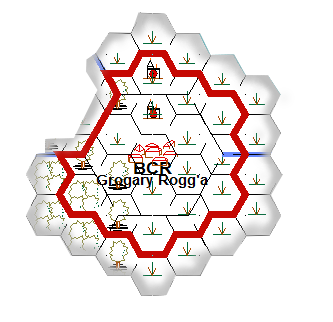
This city represents the 'remains' of the previous civilization after some kind of catastrophic event, where we've lost access to our kingdoms full resources, technological know-how and such. I've decided that my 'rebuild' have managed to secure the last mages tower, and my Chief has found a decent enough building to use as his place of leadership, and the other 2 locations are to be markets, to ensure my kingdom has a chance of rebuilding. So my starting city will be like this:


Starting City
Grogary Rogg'a
….
Turn0
Current Stores
-
Food
1000
Caravans
0
Resource
1000


Stone
0
LOCATION BUILDING
HAPPINESS
TURN MODIFIER
INCOME / COST
Chieftains Hut


-125
Mages Guild


-250
Markets
100-10+360
Markets
100-10+610
(empty for later)


Subtotal
595
Other Costs


KING/Leader
=50 x Level
e.g. 150
-150


Total
445

Without overwhelming you with any rules, lets just say that this is an acceptable start, but my income is rather low. I'll need to improve it fast if I'm going to get off the ground. This is because I chose the expensive and currently useless mage tower.. but saves me a massive later game cost to try to invent & build the mages tower.

Starting Map for the Croconians
My Map:
Not a bad start, only losing 1 cell over the river. because the terrain is all swamps, I think that being close to the forest is a good thing (wood?) but don't want to lose any more cells from that river blocking my path (rivers in this map are almost a km wide, no crossing easily.

My Techs:
I chose to take 3 random techs from the Cave-era( my choices are 2 chosen from Stone-age, 3 random from Stone-age or 4 random from bronze-age). I got Elders, Despotism & Surface Mining. .. Despotism looks interesting, minus happiness, lower tech, but Military prevents unhappiness... could be interesting.

After Watching the "account creation video" I see that I've pretty much completed all that I expect from other players.. so that's it for this Blog..

(After 12 weeks addition) - We've had a couple of drop-outs, only 2-3 so nothing too drastic, story line, its understandable that not every prince/princess is going to be as good a leader as their father/mother, so story line, accounts that are left abandoned by their players will 'play on' as Non Player Accounts, these accounts can be taken up by anyone at any time (the new crowned leader is a decisive leader) and continued, so if you're reading this blog and think, this could be interesting, pop me a line/email and you can join in as one of the untouched accounts, I'll walk you through the first first turns.

Tuesday, 22 December 2015

[worldbuilding] Discovering old maps part 2

Having discovered my old maps and deciding to rework them, I continue on my path to create a new.. old world

Part One

The Canvas

To really get a feel for what I was doing, I gathered all my maps and looked over them, drew out sketches of things, very very general sketches.. making sure certain issues were dealt with..

The first was simple world physics. The Original Coyn World was far smaller, the sun would pass overhead which would mean very long days, very hot days.. or the sun would need to move so fast you could watch it shift shadows. So I needed to 'set' the sun to match the more current world maps which I worked on the physics for months before I got it all right.

So the sun rises and falls on the rim of the coyn, but now a new problem.. in the centre of the world is a spire (because remember, that this world was more directly a copy of Terry Pratchett's Discworld). So with only a 30. degree rise, the spire would blot out the sun on the other side of the world, making winter in some areas deadly.. while interesting.. was going to break too many maps..
Zoom in to see details.

So I adjusted the rules of the sun, 40. degree, sped it up slightly to ensure an earth approximate temperature, checked the maths, then started measuring the spire. (see the little image below.. it had to get shrunk..60%)

As you can see from the image, the spire shadow would (from the 16 different months) only cover half of the world in winters shadow.

Now, since I was going to use the zoomed in section, I needed to ensure that any nearby mountain ranges might not interfere with the suns rays.. there was.. you can see the mountain with the green sun lines to determine its midday ranges..

Next, I plotted out the suns direction to give me some workable lines. I no longer had the cad program I used before and I calculated the time it would take to make a new program to work the maths, would exceed the time I would take to simply draw lines on a map myself. So I drew the lines myself.
One Shadow Map

I'm not going to bore you with 16 variants of map, just one. What I did was work out the distances the sun was from the local hills, and the height of the sun at 9am, midday and 3pm, and "shifted" the mountain peaks lines in an art program and filled in the shadows with a darker colour.

Shadow Lines, Shadow Months & Sun Levels
Then I blended all images together to give me a colour coded map for the 4 months of summer, winter, spring and autumn so I could determine biomes. If an area got 2-3 hours of sun, mid-autumn, but remained in the shadow of the local mountains, its going to be a colder region, and will less likely to have temperate forests, so I'd colour those zones with a light green/blue, if it got sun all 18 hours of the day, all times of the year, its going to be a desert.

Rainfall Levels
Next I started adding Water. Simple google searches explain how water evaporates off the ocean, flows across the land, then when it hits mountains it becomes rain and produces forests and rivers and the like. So I mapped out the general flow of the clouds and map a map of that.

Forests in Green, Deserts in Yellow
Next I made sure my river beds on the original maps matched the flow of water coming from the mountains. I had made some mistakes, but mostly it was ok, so I matched the rivers to the shadows to the biomes and drew in the spots where forests could grow (not would.. just could).

Then I scanned all these, and overlayed them in the art program, and this gave me the 'concept' of where the forests 'would be' before humans started chopping them down and building places.

Not that its easy, but you might be able to see that my original 1991 maps have quite different forest lines to the new more legit maps
Lots of little trees, all those green dots.. (yes I'm using copics)

So far so good.


So my new map now has a very cool desert like terrain, not exactly Sahara, but more Australia/Arabia/Egypt, so that unlocks some opportunities. Also the larger expanses of plains on the east, could be used for some battles.. European style.. and now the central valleys are all cold.. snowy cold.. so I can also make some cool little Russian/Mongolian Taiga locations.

Plot-hooks

The Main draw card for this island, is the History. 12 gigantic Ziggurats from an ancient civilization of 9ft tall crocodile people, built of gold, (based on the 'cities of gold t.v. series when I was a kid). Heroes across the world catch boats here, travel through the cities, spend their money, and some return from the ziggurats with a gold brick the size of a dog, enough to retire the entire group, if they so wish.
My notes are sketchy as to what they contain, but I have some maps and a few pages of notes, so I just need to piece it together (and re-watch the t.v. series to see if it sparks any memories). the main point comes from one line at the top of the page:

"The Ziggurats are heavily guarded, not by living creatures, as they would have died eons ago, no but by traps, ingenious deadly traps, that are designed for 9ft tall priests, who know the correct path, to be able to traverse safely, at the right time, in the right season."

My notes only included traps that players came across, (I used to make everything up as I went). Chessboard battles, Illusionary chasms, a Cart-Voodoo puzzle and some giant cat statues that shoot lazers? So now I just need some ingenious traps to flesh out the rest of the rooms..

Lastly, because I never got around to finishing it, I'm putting the dead remains of one of my old roleplay groups, in a set of Crypts that guard ancient treasures that they collected

Sunday, 20 December 2015

Narrative Sharing, my two cents

Just Wanted to jump on the bandwagon of this wave on the interwebs.

You can look at the arguments across some of the forums, from here and here and here and here

TL;DR; If used sparingly, a narrative mechanic might work, but you gotta be a dang good GM to know how to use it.

Should Players have Narrative Control?

Sure, about themselves, their characters, their decisions, for the most part. When players suddenly decide their law abiding paladin decides to slaughter innocent children, I gotta ask the player.. "hey buddy, that makes zero sense for your character, should we talk about whats happening?" So maybe not 100%.

When it comes to asking the now famous question: "Do I see a rock nearby?" or the other "is there a Botany book in this library" Now we're getting to some of the problem.. I'm thinking, probably yes, but, ... and I'll get to that..

When a player starts saying things like, " I wanna play an elf" and I say, "sorry, but the campaign is set too far from any reasonable expectation of an elf being within dragon-spitting distance, let alone born here, what is it you want to play?" we're not talking narrative, we're talking setting.. so thats another point.. kind of a yes.. but.

If a player ask, in my Pratchettesque fantasy setting, " I want to buy a glock.38" then I'm going to look at him quizzically and say, "you do realize this is a fantasy game right? no guns?" so that's a plain.. No.

Working backwards:

Setting, I hope it doesn't need to be explained in detail, no-one is really arguing that a player insists on breaking the setting, and that a GM need to allow it. strike it off the list.

Bending the setting, When a player wants to create his character that's not really permissible. Early GMs might capitulate because they don't know or haven't experienced how sometimes saying yes to make the player feel good, will break the world. My example of an Elf above, would suggest, somehow against all logic and reason, some Elven parents managed to sneak into territory hostile to elves, have a kid, raise him, all the while disguising themselves and their kid until adult-hood, enough that he can now become an adventurer with the group. This is when my players can use my Karma system, what would be Fate/Bennies/points that could make this 'background' ok, why? Does that break my world? no because its setting, we haven't started playing, its developing their own character, their background, in a way that is interesting to the player and the group.

Ok, struck from the list.. Now for in-game player narrative..

Looking at the Idea, Is there a Book about Botany in the library. To start most would agree, It is pre-destined or it is unknown.  In the case of the pre-destined book existing we have the concept of, the GM pre-thought the books existence or non-existence, and is in his notes. "the Library contains only roleplay manuals". But realistically, a book about botany not existing in a library, sounds quite far-fetched, so maybe the GM takes a moment and thinks.. hmm, well maybe..

So we're left with the Schrodinger cat conundrum, Does the Book exist or not? Like many before me have spoken, There seems two camps of thought..The Book has a chance of existing, because the world has a statistical chance of it existing, or the Book exists because of Narrative reasons.

With the chance of existing, the statistical value is based on factoids that the GM mostly knows, but maybe the players might also know if its a published adventure world, such as forgotten realms or Warhammer40k. In this case, most GMs who follow this style of GMing would roll a percentile dice of chance to see if the book exists. If it does, it does, the GM didn't decide that it existed, the plot didn't decide, The statistical chance determined that is was there all along, the percentile roll only determined that the player found it. Actually, the roll might determine that the player didn't find it, but its still actually there.. If a tree falls in the woods, does the GM hear it?

From the Narrative point of view, the Books existence is based on the flow of the story. If the player has an idea and the idea doesn't directly break the GMs current world view, he allows it, because the player has more narrative control.. and this seems to be the whole argument..

Did the book exist? or did it pop into existance because the player, and not the GM determined it needed to exist.. will this break the world?

Some game systems and Improv Theatre roleplay groups insist that this be the norm, if the GM didn't previously state that it was not so, then the players should be able to include it, sometimes for some kind of point/luck/benny/fate cost.. 

Now sure, if a group decides together that this should be the way they play.. go for it.. find out the dangers and benefits, play to their hearts contents, but don't for a second expect me to listen to your story with any level of immersion, its like kids explaining how cool it is to play a game with god-mode on, or how cool minecraft is in creative mode.. no.. its not cool.. I'm not going to say that to their sweet little cherub faces of course, but I know deep down that they've missed out on the very reason roleplay games work.. 

Experience, creativity, boundaries and obstacles.

Its fun to figure out a puzzle, we get the boundaries and the obstacles, we use creativity and when we solve it we are wiser for the experience. If we can suddenly change the boundaries, how will be ever be able to learn how to solve the original puzzle? we've changed the puzzle and we solve, probably an easier version, probably we've changed it to something we've already done before, because its easier, so we don't even learn anything new.. 

Lets look at the rock in the above example..

The Player stands in a stream and says "Oh I need a rock, is there one nearby?"

Every GM says, of course there's likely to be a rock in a stream, and lets them have one. I say.. Hang on.. what is the player asking? I have an idea.. I want to use a rock for something.. spell component or throw it or.. something.. In a movie, there will be a rock if there needs to be, because we like luck to favour the hero. If the plot determines that a rock will make the event too boring too easy, then there is no rock.. but that's a movie.. Its understood by the writer and director where the movie is going so they can balance this exactly as needed.. but a GM, on the fly? with a player who hasn't told the GM what the rock is for yet? how can he judge if that rock is going to make or break the plot.. so its easier to determine.. likely that rock exists in reality, the player wants one.. so let him have it.

I might think also.. wait, is that player always 'coming up with ideas at the last moment? and using his fate/benny/luck to change the plot? how will a person grow, if he expect life to always have things ready for him.. so maybe the rock will be there, but not accessible, not right this very combat round.. so he thinks, next time, next time I'll get a rock and be prepared, have one in my pocket.. like a good adventurer should.

That's sorta "yes, and" but I've created an obstacle to what they wanted, because they thought of it at the last second and wanted 'god' to 'shift' reality to accommodate, which I hate to do, but they are heroes and they should be lucky, because roleplay is a little cinematic.. but they have to use the luck.

Why is this acceptable to me? because dice are fickle, and narrative is not supposed to end because someone rolled a 1 at the wrong time, but I don't want to bend the rules, because then it never ends.. and when I've played games with GMs who rule bend to keep the narrative, I got bored almost instantly.. why bother to try so hard if the GM is just going to allow me to do my cool thing because it fit the narrative or as much it didn't break the narrative. So I included a mechanic, dice are fickle, monsters and NPCs might die because life is like that, but you are heroes, so if you make a choice and it results in poor dice rolls, you can use your luck to take back that roll, and live another day.. but learn from your mistakes, because you have a limited pool and once they run dry, you've out of luck.

For systems without some kind of saviour, I don't see an answer. fickle dice will kill a straight simulationist story, but player narrative will destroy players agency in the long run, and make a game boring. finding the right balance is hard.. which is why people will argue about it.


Friday, 2 October 2015

Devils Advocate to RPG-think

An interesting read at the ConTessa blog, about worldbuilding and how 'trope-heavy' RPG worlds are broken:
and
Got me thinking about how this is a very simulationist way of thinking (I use the term only because I have yet to find/invent something better), but I wanted to address the many points, and posting heavy text blocks in someone elses blog seems.. excessive.. or even rude.
So I'm going to play:

Devils Advocate to RPG-think

I won't assume you've read the article, instead I'll sum up the points and address them from the narrative perspective. 

1. Magic Shops: The Premise

So, the idea is, that in each and every town is a supposed magic shop full of ingredients and components, spell books and scrolls, potions and the like. The likelyhood of this happening is next to zero, so why does every fantasy RPG do it?

Lets set up some understandings. to be an RPG world, you can't have just one set of heroes. Its not a 'these are the only heroes there are' story, because if it was, the entire premise of anyone having magical potions available for heroes is preposterous. Every single potion, scroll or magical weapon would be unique items, made by unique people, for unique reasons.

Ye Olde Madgick Shop
So then we are left with two possibilities: The world has a fair number of heroes, or the world is filled with heroes.

With a filled with heroes concept, then its obvious that every town or village should have a magic shop. They become the 7-11 of the fantasy world. This in itself should require the simulationist GM to need to label the bottles 'McDonalds Healing Potion" or "Healthy Meal" with 1 potion, 1 ration and 1 charm (one use) resist all.

The 'fair number of heroes' premise, would be something more akin to a car salesman. you're not going to make sales often, but when you do, you pay all your bills for the year.

Personally I like this idea.. little old man, alchemist, retires, has a little shop front, makes salves for the locals, in case they scratch their knee, but need to dance that evening. but once in a while, he breaks out the expensive stuff for the heroes that pass through, the gold they dump on him, buys the next 2-3 sets of ingredients to brew them up again, pay off any debts/tabs built up since the last time, plus some change to buy Christmas gifts for the next 10 years.

For Narrative GMs:
Players are not really taking note of the reasons for the magic shop to exist. There doesn't need to be a magic shop in every single town, it just so happens, there is in every town the players happen to go in.


2. Thieves Guilds: The Premise.
 
Suprisingly (or not) finding images of a Theives Guild was hard
Mostly just in game images. Art by Isriana

Here, the idea is that, since earth has very little proof of guilds of thieves existing, therefore, they didn't exist. This suggests that they were just good at what they're supposed to do. Remain hidden from public. The Mafia always seemed like a thieves guild to me.
Moreover, the concept is that any kind of 'guild for one class' would have far reaching effects upon the world at large, heirachy, dues to the city council, power play, etc.

Now, the effect would be far more prominent if we have a filled heroes world because almost every hero would belong to a guild, and there would be some kind of guild in-fighting.

A fair heroes world, would be more likely to have singular guild halls, with affiliations to other guilds. Asian fighting schools had this, students could travel to a nearby town and talk to the dojo master about his own master, and if they were friends.. he could stay for the night, maybe even train somewhat.

For Narrative GMs
Unless your plot involves or revolves around the interplay between guilds, there is no reason for the players to see any. Ignore this and include them as you will.

3. Temples for each god: The premise
 
City of Churches You'd need a city just to fit one of every church - Art by Chao Yuan Xu
For each Cleric/Paladin/Priest to access their spells, they need to pray to their god in a specific temple? I was not aware of the rule myself, but even if we disclude(yes, the taking out of an included item) the requirement, pretty much most villages have a local temple to the local pantheon.

I'm not really at all sure why this is considered strange. All across Europe I saw temples and churches to multiple religions, if the town was big enough. Cities would have hundreds of them. Not one temple would turn away a person who wanted to pray, regardless of religion.

Now, sure, maybe some gods hate other gods, so praying in a rival gods temple might be considered rude or worse. But surely the gods wouldn't require their followers only worship in a temple. They'd lose half their followers (I was mid adventure, but my god didn't answer me, so we called off the quest)

For Narrative GMs
Again, your players are traveling to places where your god has sway, unless the plot requires that your cleric has limited access in these lands, creating a power sink for the group, to make the next scene more dangerous (and the players have to think more with a low/no powered cleric).

Conclusion
Worldbuilding, can be in many ways, the opposite to Plot building. Maybe instead of Narrartive vs Simulation, it should be called world-built or plot-driven styles of play.

For Narrative/Plot driven play, there is no need to care if your world 'works' or not, the shop keeper is surly because the story works best that way, not because he had a bad argument with his wife the night before, about the lack of flowers for her anniversary.

But for World Builders, these things are critical. You can't have magic shops, thieves and fighters guilds and player specific temples in every town, you need to map out the influences of each of these forces, and how they came about in the world, to ensure that they are robust. 

More to come on this train of thought.